



Ly Dynasty (1010-1225)
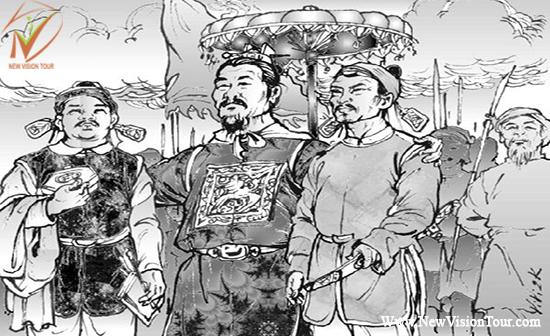
Kings
of Ly Dynasty:
-
Ly Thai To (1010-1028)
-
Ly Thai Tong (1028-1054)
-
Ly Thanh Tong (1054-1072)
-
Ly Nhan Tong (1072-1127)
-
Ly Than Tong (1128-1138)
-
Ly Anh Tong (1138-1175)
-
Ly Cao Tong (1176-1210)
-
Ly Hue Tong (1211-10/1224)
-
Ly CHieu Hoang (1225)
After a long period of
subjugation by the Chinese feudal empire, a period marked by numerous
insurrections, the Vietnamese people finally won back their independence in the
10th century. Following the recovery of that independence, the
country gradually turned towards creating a centralized monarchical state. This
centralization was made necessary by twin factors: the construction of great
hydraulic works, particularly dykes and canals for the development of the
agriculture, and the safeguarding of national independence against attempts at
reconquest by the Chinese imperial Court.
However, before organized a well
monarchical state could be set up, the country went through a period of
instability during which tendencies towards feudal domination still persisted.
It was only with the establishment of the Ly Dynasty in 1009 that the monarchy
was able to gain a secure hold on power.
In 1010, after his
accession to the throne, Ly Cong Uan, whose royal name was Ly Thai To, ordered
the transfer of the capital to Thang Long, the site of present-day Hanoi. Thang
Long was to remain the capital until the 19th century. Ly Thai To decreed a
general amnesty for prisoners and the destruction of all instruments of
torture. In 1054, his successor, Ly Thanh Ton, renamed the country Dai Viet.
The king owned all the
land by right. The state, however, directly utilized only a small portion of
this land, some of which was distributed to members of the royal family and
high-ranking dignitaries as fiefdoms and personal domains. Taxes were levied on
land owned by villages and individuals. There was thus an agrarian regime with
several sectors:
+ Land used by the
state;
+ Fiefdoms and domains;
+ Communal land; and
+ Private land.
There were two
categories of land distributed to nobles and high-ranking dignitaries. There
were fiefdoms whose beneficiaries had both the land and people at their
disposal; the peasants had obligations only to their local lord, and were not
required to pay taxes or provide labour to the state. In the great domains, the
peasants paid rent and taxes to the owner and at the same time had obligations
to the state, and remained directly subject to the monarchy. Marshal Ly Thuong
Kiet, for instance, received in appanage 4,000 peasant households, but his
domain comprised another 10,000 households. Appanages and domains remained the
property of the king. When a lord died, his heirs could inherit his land but could
also be dispossessed by the king.
Kings Ly attached great
importance to agriculture. At the beginning of each year, continuing a
tradition inaugurated by Le Hoan, the king himself made a symbolic gesture by
ploughing a plot of land, following a ceremony in honour of the god of
agriculture. In 1038, when King Ly Thai Ton was advised by a mandarin not to
demean himself through such an action, he said: "If I myself do not do
some ploughing as an offering to the god, how can I set an example for the
entire people?"
Those who stole or
killed buffaloes were severely punished under the law.
The dykes were give
particular attention and mandarins were held responsible for their maintenance.
The construction of numerous dykes and other hydraulic works is recorded in
annals, for instance the Co Xa dyke in 1108, and the digging of the Dau Nai
canal in 1029, the Lam canal in 1050, and the Lanh Kinh canal in 1089.
From the beginning of
their reign, the Ly endeavoured to consolidate the state apparatus. The country
was divided into 24 provinces entrusted to close relations of the royal family.
The centralized monarchy governed with the assistance of this aristocracy.
Princes of the blood had their personal appanages and their own armed forces.
The court hierarchy was a strict one with a twin body of civil and military
mandarins. These mandarins received no salaries and lived on the money from
rent and taxes paid by the population under their administration. But a
mandarin bureaucracy gradually came into being, paid by the monarchy through
taxes on landholdings, handicrafts, forest products, and market sales. Little
by little, the administration lost its family-based character.
Bonzes played an
important role as advisers to the king. The founder of the Ly dynasty was put on
the throne with the help of a prominent bonze superior, Van Hanh. The bonze
Vien Thong received honours reserved for the heir to the throne.
The Ly also introduced
written laws. In 1042, King Ly Thai Tong ordered his mandarins to "amend
the laws and regulation so as to adapt them to the present circumstances, to
classify them, to compile them into a penal code that can be easily understood
by all". It is reported in the annals that the code, when completed and
made known to the population, was welcomed by all. The rehabilitation of
delinquents and criminals was instituted; very severe punishment was decreed
for the "ten capital crimes", particularly that of rebellion. Under
the Ly, it was forbidden to sell 18-year-olds as slaves; there were laws for
the protection of draught animals and on the mortgaging of land. Penalties were
prescribed against piracy and extortion by mandarins. This legislation was
perfected by the Tran. It should be noted that the law paid special attention
to the prevention of rebellion. While the delta had a homogeneous Viet (or
kinh) population, the mountainous regions were inhabited by numerous ethnic
groups, and the relationship between the central government and these mountain
populations constituted a particularly difficult issue for the monarchy. The
historical relationship between the Viet majority and minority groups was one
of both integration and antagonism. On the one hand, the delta and highlands
were integrated economically and needed each other; they were also closely bound
by the need for mutual defence against foreign aggressors. The different groups
were therefore moving towards progressively uniting as a single nation. On the
other hand, the Viet feudalists, particularly the monarchy and mandarins,
sought to exploit and oppress the minorities, leading to frequent revolts and
the ensuing reprisals.
In the 11th century,
when the Ly dynasty was founded, the frontiers of Dai Viet in the north and
northwest had not yet been clearly delimited. Particularly important was the frontier
with China in the north and northeast; these regions were inhabited by Tay and
Nung people whose allegiance was of prime importance for the Dai Viet kingdom.
It was vital to incorporate them into the nation.
The Ly king often
sought alliances with local chiefs by giving them princesses in marriage or by
marrying their daughters.
At the Chinese court,
there still existed a faction which advocated the reconquest of Dai Viet. In
1069, in an attempt to find the remedy to a serious economic and social crisis,
the Sung emperor gave full powers to a bold reformer named Wang Nganche. When
the reforms proved a disappointment, Wang Nganche, to save the Sung's prestige
and seize Dai Viet's wealth, decided to send a great expedition against the Ly.
In 1074, the provinces of southern China received the order to strengthen their
armies, arm combat junks, and stop trading with Dai Viet.
At the Ly court, given
that the reigning king was only ten years old, all power was concentrated in
the hands of General Ly Thuong Kiet, who decided to take the offensive in order
to forestall the Sung.
Two army corps totaling
100,000 men were sent to China in 1075, one overland under the command of Tong
Dan, a Nung chief, the other by sea, under the command of Ly Thuong Kiet
himself. The latter cleverly exploited the discontent of the Chinese population
with Wang Nganche's reforms, and appeared as the liberator of the peoples of
southern China. Placards were put up denouncing the reformer and proclaiming
that Ly Thuong Kiet's only desire was to ensure the welfare of the people. The
Ly troops were enthusiastically welcomed by the population and easily occupied
many localities. The general attacked the Yung chow stronghold which fell after
a siege lasting 43 days on March 1, 1076. The citadel was razed to the ground;
other strongholds suffered the same fate.
The Sung
prepared for a counter-offensive by forming a coalition with the Champa and the
Khmer kingdom. In April 1076, having attained his objective to destroy the
Chinese staging posts, Ly Thuong Kiet withdrew his troops from Chinese
territory. Early in 1077, the Sung troops, having forced their way through the
frontier passes, were facing the Ly army across the Nhu Nguyet River (now the
Cau). Fierce fighting ensued and the Sung army was unable to cross the river.
It was in the-course of this battle that Ly Thuong Kiet composed a poem and had
it recited during the night, making his men believe that the river god was
speaking:
Over the southern
mountains and rivers, the Emperor of the South shall reign
This was written down
in the Book of Heaven.
How dare those
barbarians invade our soil?
They will surely meet
with defeat.
Its morale higher
than ever, the Ly army repelled the attackers, who were also being decimated by
disease. Ly Thuong Kiet then made a peace proposal, which included the ceding
of five frontier districts (now Cao Bang and Lang Son provinces). The Sung
accepted. This was in 1077. Two years later through negotiations, the Ly
recovered the ceded territory.
Ly Thuong Kiet was
the architect of the victory. An outstanding strategist, he was also a great
politician who knew how to win the hearts of the people and inspire his troops
with enthusiasm. The stability of the regime established by the Ly was
confirmed by this brilliant victory over the Chinese imperial armies. The Tran
further strengthened the country's armed voices, enabling them to repel a
Mongol invasion two centuries later.
Buddhism was at its
peak under the Ly, whose accession to the throne had been favored by the Buddhist
clergy. In return, the latter received the highest privileges. The kings
themselves were interested in the study of doctrine and often took bonzes as
advisers. The pagodas owned large domains worked by serfs, and bonzes were
exempt from taxes and military service. Kings and princes had large numbers
of pagodas built and bells cast, and promoted the dissemination of sacred
books. In 1018 King Thai To sent a mission to China to gather texts of the Tam
Tang: in 1068, King Thai Tong oversaw the creation of the Thao Duong sect, and
several kings became patriarchies of Buddhist sects. Princes and nobles
followed their example. Beautiful pagodas were built under the Ly, some of them
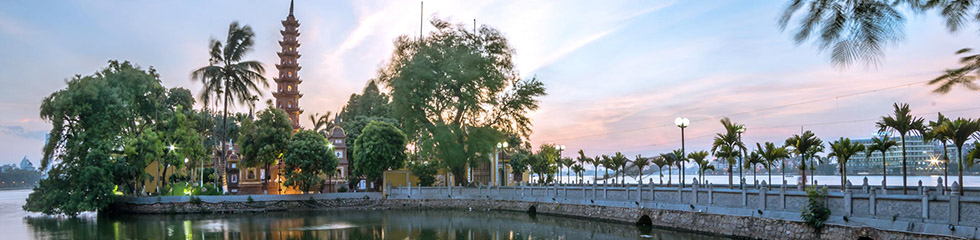
preserved up to the present day, such as Quan Thanh in Hanoi built in 1102,
Dien Huu (1041), Bao Thien (1050), and Keo Pagoda in Thai Binh Province. Queen
Y Lan, accused of ordering the assassination of one of her rivals, spent the
rest of her life building 100 pagodas to redeem herself. Vietnamese Buddhist
Sects and schools were founded.
In a
society whose members had to unite in the face of great natural calamities and
the permanent danger of foreign invasion, and who came under the absolute power
of a monarch governing through a complex mandarin bureaucrecy, a doctrine was
needed to direct the mind of each individual towards his social obligations,
obedience and loyalty to the monarch, and unconditional respect for the social
hierarchy. Since the Han, Chinese imperial dynasties made Confucianism the
state doctrine; the Vietnamese monarchy gradually adopted it.
In 1070, Ly
Thanh Tong had the "Temple of Literature" built. This was a school
dedicated to Confucius and his disciples and was where the sons of high-ranking
dignitaries received moral education and training in administration. In 1075,
the first mandarin competitions took place, through which Confucian scholars
could accede to public office; the competitions were only open to the sons of
aristocratic families. In 1080, competitions were held to recruit members of an
"Academy", whose task was to preserve the archives and write royal
edicts. In 1089, the mandarin hierarchy began to be strictly organized. The
appearance of Confucianism on the scene was the consequence of a dual
phenomenon: on one hand was the necessity of creating a mandarin bureaucracy
and on the other, there was the increasing accession of educated commoners to
public office. At first, these men were given only subaltern positions, higher
offices being reserved for members of the royal family and of the aristocracy.
The Ly period also
saw the appearance of the first historical works. Under the Ly Dynasty, Do
Thien compiled a history of the country which, now lost, was mentioned in Viet Dien U Linh and Linh Nam
Chich Quai.
Cheo popular theatre, which first appeared
in the 10th century, continued its development. A prisoner captured during the
Mongol Invasion, Ly Nguyen Cat, made a notable contribution to tuong Classical
theatre.
It was
architecture and ceramics that reached a level of excellence during the Ly period.
With the spread of Buddhism, many pagodas were built. Some of the most famous
have been preserved. Unfortunately, however, the ravages of war and climate
have destroyed the majority of the works of art from this period. What remains
can only give us an idea of what was achieved at that time. Some works from the
Ly period have been erroneously classified by French historians as being from
an earlier period, that of Dai La (9th century).
On the
stele of Linh Xung, erected in 1126, an inscription records that "wherever
there was beautiful scenery a pagodas was built ". One of the essential
characteristics of these pagodas was harmony with the surrounding landscapes,
the building nestling amidst trees, and the gardens and ponds, an integral part
of the construction; most often, the background was a hill or winding stream,
and the slow ringing of bells in the calm morning or evening seemed part of
nature itself.
Some
pagodas had to be of significant size, since they would accommodate thousands
of pilgrims coming to take part in great celebrations. Dien Huu Pagoda,
commonly known as the One-Pillar Pagoda and built in 1049, is a graceful
pavilion built on a stone pillar standing in the middle of a pond, the whole
complex resembling a lotus flower in bloom.
The lotus
flower motif often appears on monuments. The flower symbolizes beauty and
purity, for "though springing from mud it is free from the stench of
mud". Stone pillars, some of significant size, often rest on "lotus
flowers"; the remains of a pillar in Giam Pagoda, built in 1086,
has a base measuring 4.5 metres in diameter and is over 3.5 metres in
circumference. At the foot of some of these pillars are carved stones
representing waves, and the columns seem to emerge from a stormy sea. A couple
of dragons climb the pillar, forming graceful but complex spirals.
The pagodas have
curved roofs and often comprise a tower with as many as 12 storeys. These
pagodas are noted for their architecture, statues and sculptures.
At Phat Tich Pagoda,
the bases of pillars have stone sculptures representing the bodhi tree (of
Buddhist enlightenment) in the center with two worshippers presenting offerings
and behind them. four musicians dancing and playing various instruments. The
ground is littered with flowers. The atmosphere is joyful and the gestures
graceful, far from Buddhist meditation on the unreality of this world.
Relic found in the northwestern suburbs of Hanoi,
where the palace of the Ly was located; show it great variety of sculpture,
statues and decorative motifs on ceramics. A frequent motif is that of the
crocodile, with head raised, protruding eyes looking to the right and to the
left, and quivering nostrils; the body is lithe and the beast standing on its
hind legs seems ready to spring. Stylized lions on ceramics have also been
found.
Excavations in 1965 on the site of the Chuong Son
Pagoda built in 1105 unearthed images of birds with human bodies among other
motifs -chrysanthemums, phoenixes and dragons - all frequently found on the
works of the period. There is a great variety of products: articles for both
daily use and decoration, and pottery and porcelain ware with fine enamel.
Among the most beautiful enamels are the opalescent-green and brown-grey ones
with a low shine and in various shades. The decoration is varied - flowers,
dragons, lotuses, birds, and where the surface permits, frescoes and landscapes
with human figures. The drawings and bas-reliefs always have a natural look
with graceful lines and a cheerful environment: the movements of birds, elephants
and dancers, harmonize with flowers in bloom or contrast with the antics of
warriors. Particularly remarkable are the richly decorated porcelain items.
Ceramics were sent as far as China to be sold or presented to the imperial
court. Under the Ly dynasty this art reached its peak.
